Hainan eyes gasoline-free vehicles by '30
Province leading way to make internal combustion engines relics of the past
By CHEN BOWEN in Haikou | China Daily | Updated: 2026-07-15 08:12


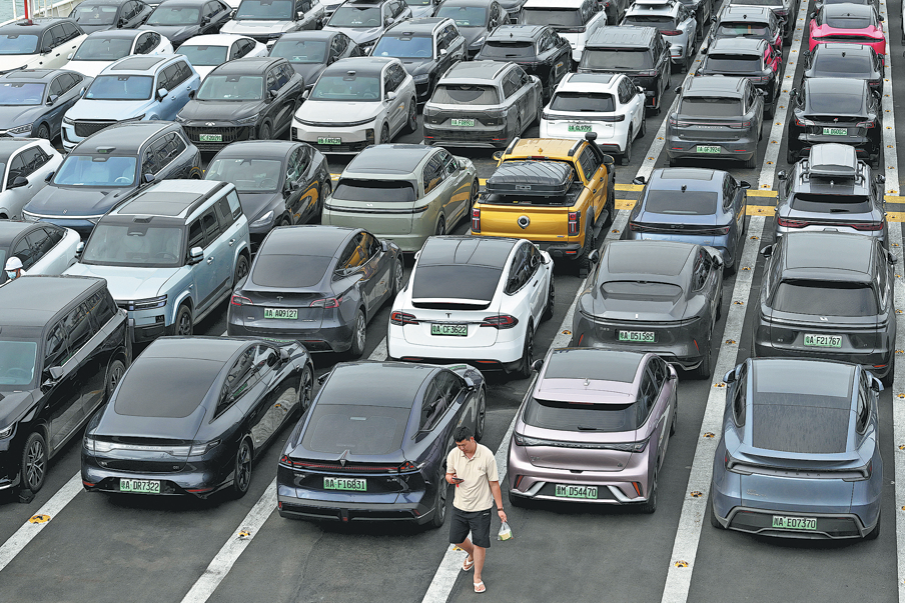
Hainan province has set a 2030 deadline for banning the sale of new gasoline-powered vehicles, making it China's first provincial-level region to adopt such a policy.
The mandate is part of a plan by the province for the national ecological civilization pilot zone, which aims for new energy vehicles to account for 45 percent of total vehicle stock by the end of the decade, up from 23.75 percent in 2025.
The rule applies only to sales of new pure internal combustion vehicles. After 2030, gasoline-powered vehicles already registered will remain legal to drive, pass inspections and be traded. Plug-in hybrids and extended-range electric models will still be available for purchase, and gasoline-powered vehicles from outside the island can continue to enter for tourism.
Hainan's move follows a trajectory that began in 2018, when the province first suggested the island phase out fossil-fuel vehicle sales before 2030. In 2019, Hainan became the first province to publish a detailed NEV roadmap. That commitment was reinforced in the province's carbon peaking plan in 2022 and again in its transportation network plan in March of this year.
The province has already made significant progress in NEV adoption. In 2025, Hainan sold 116,800 NEVs, or 62.9 percent of all new vehicle registrations. By January 2026, the monthly NEV penetration rate reached 55.13 percent, said the province's department of industry and information technology. The province led the nation in April 2026 with 74.5 percent penetration. NEV manufacturing in Hainan generated 3.34 billion yuan ($493 million) in output in 2025.
Several geographic and economic factors make Hainan particularly suited for the green transition. The island's tropical climate eliminates low-temperature battery degradation that negatively impacts NEV performance in northern regions. The coastal scenic highway falls within the single-charge range of many mainstream electric models. Additionally, Hainan does not levy separate highway tolls, but instead incorporates road maintenance costs into gasoline prices through a 1.05 yuan-per-liter surcharge, inflating fuel costs above mainland levels. In May of this year, 92-octane gasoline in Hainan was 9.89 yuan per liter, compared with 8.74 yuan per liter in Shanghai, giving electric vehicles an immediate operating cost advantage.
The province has also built supporting infrastructure. Hainan Power Grid Co Ltd has developed an integrated "one-network" charging and battery-swapping platform that connects 73,000 charging outlets, achieving 100 percent public charging infrastructure coverage. The system provides 25-minute charging circles in downtown Haikou and Sanya, along with a 100-kilometer fast-charging corridor on intercity highways. The grid is also piloting 354 smart charging stations that can adjust power output based on grid demand, and 12 vehicle-to-grid stations that allow owners to sell stored energy back to the grid.
Beyond passenger vehicles, the plan extends to broader transportation sectors. Hainan will pilot fuel-cell vehicles in heavy trucks, cold-chain logistics and public transit. The province also aims to build zero-carbon port freight corridors, expand shore power for vessels, promote sustainable aviation fuel at airports and advance rail freight conversion projects to shift cargo from roads to rails.
Experts suggest Hainan's model may influence other regions. Guangdong province and Shanghai, with high NEV penetration rates and mature charging networks, could adopt phased approaches.
Targeting peaking carbon emissions, Hainan's initiative represents a significant step in restructuring the country's transportation energy system.
chenbowen@chinadaily.com.cn
Related Stories







Editor's Pick