Pakistani PM honored for agricultural alliance
Sharif expresses hope to learn more from China's experience, expand cooperation
By Zhao Yimeng | CHINA DAILY | Updated: 2026-05-27 07:04


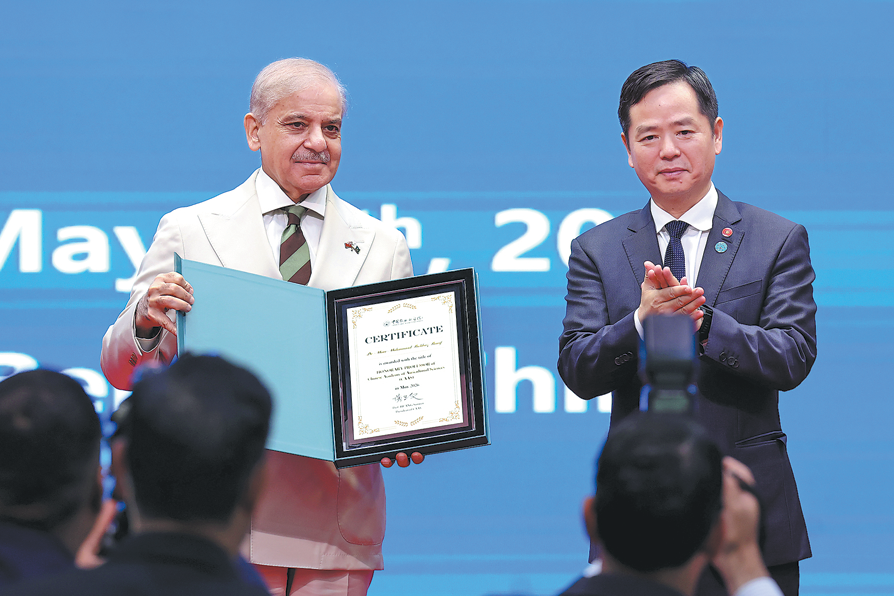
Pakistani Prime Minister Shehbaz Sharif was awarded the title of honorary professor by the Chinese Academy of Agricultural Sciences on Tuesday in Beijing, in recognition of his contributions to promoting agricultural science and technology cooperation between China and Pakistan.
Speaking at the ceremony, Sharif said that agriculture remained a key topic of discussion during his meetings with Chinese leaders.
He said that Pakistan hopes to learn from China's development experience and expand cooperation in areas such as crop breeding, animal husbandry, climate-smart agriculture, agricultural machinery and agricultural product processing, in order to improve productivity and added value.
Sharif announced that Pakistan will launch the second phase of its "Thousand Talents Plan", which will see 1,000 more young people from Pakistan sent to Chinese agricultural institutions to study and undertake training.
"I propose sending 1,000 students and fresh agriculture graduates from all provinces of Pakistan to Chinese universities for formal courses and modern agricultural training," he said.
Sharif's four-day official visit to China, which concluded on Tuesday, is an important high-level exchange between the two countries as this month marks the 75th anniversary of diplomatic relations.
His announcement was warmly welcomed by Pakistani students at the academy, many of whom view China's agricultural modernization as a model for Pakistan's rural development.
Nadeem Sarwar, a Pakistani scholar pursuing a PhD in agricultural water resources and environment at CAAS, said that the initiative would create valuable opportunities for more young people in Pakistan.
"More Pakistani graduates will have the opportunity to gain knowledge, experience and exposure at Chinese institutions. When they return to Pakistan, they can contribute to developing the agricultural sector there," he said.
Sarwar's research focuses on improving the efficiency of agricultural water use, an issue he said is particularly important for Pakistan.
"China has made great progress (in agriculture), especially in improving water-use efficiency," he said, adding that he hopes to use China's technologies and experience to boost Pakistan's agricultural productivity and improve its management of resources.
Muhammad Shahzad, also a PhD scholar at CAAS, who is studying animal genetics, breeding and reproduction, described the occasion as "a really big day" for Pakistani students. "It is a matter of great pride for all Pakistanis that China truly acknowledges Pakistan and values our friendship."
Shahzad noted that Pakistan's livestock industry plays a major role in the country's agricultural economy, and that scientific breeding is essential for improving productivity. "Our animals are resilient to hot weather and diseases, but we need more scientific breeding," he said.
Huang Sanwen, president of CAAS and an academician of the Chinese Academy of Sciences, said that CAAS has established multiple joint platforms with Pakistani partners, including laboratories for cotton biotechnology, sustainable crop pest control and molecular breeding of wheat.
Huang said that the academy has also promoted cooperation in crop breeding, prevention of animal and plant diseases, water and soil resource management, and agricultural product processing.
CAAS has trained more than 300 Pakistani students over the years and established a China-Pakistan Agricultural Technology Working Group with the Pakistan Agricultural Research Council, to institutionalize cooperation and strengthen capacity-building efforts, he added.
He Zhonghu, a researcher at the academy's Institute of Crop Sciences, who has worked with Pakistani researchers for more than two decades, said that China and Pakistan have already achieved remarkable results through joint agricultural research.
A wheat variety developed by Chinese and Pakistani researchers has recently been approved in Pakistan following years of field testing.
The variety yields about 10 percent more than local varieties, matures earlier than them and has strong resistance to lodging (stem bending or breakage), said He, who is also an academician of the Chinese Academy of Engineering.
"We are very happy to contribute what we can to Pakistan's agricultural development and food security," he added.
The researcher, who has trained 10 Pakistani PhD scholars and a number of agricultural technicians at the institute, said that future training methods should focus more on applying new technologies rather than on basic research.
For example, students studying genetics or wheat breeding should also be taken to experimental fields, seed companies and flour mills for hands-on experience, he said.
zhaoyimeng@chinadaily.com.cn






Editor's Pick