Crisis threatens more supply chain snarls: Experts
By BELINDA ROBINSON in New York | China Daily | Updated: 2026-03-20 10:27


The US-Israel conflict with Iran and the subsequent retaliatory strikes by Iran across the Middle East have created extra challenges for businesses around the world that rely on quick access to a smooth-running global supply chain, experts said.
The delay in transporting key exports through the Gulf region and the Strait of Hormuz — through which 20 percent of the world's oil supply flows — threatens to disrupt supply chains further, as the waterway has been effectively, but not officially, closed since the fighting began three weeks ago.
"In an era when firms carry minimal buffer stock and rely on highly optimized supply chains, a prolonged war that creates disruptions in air and shipping routes would most likely cause severe supply chain shocks with a ripple effect reverberating throughout the world," Mohammad Elahee, a professor of international business at Quinnipiac University in Connecticut, told China Daily.
While the strait, a narrow waterway located between Iran and Oman, is mostly known for transporting oil, other vital goods pass through it, too.
It sees "roughly one-third of the world's seaborne fertilizer, petrochemicals, plastics, and aluminum. Container ships also transport food, medicines, consumer goods, and machinery, particularly between Asia and Europe," according to the US Energy Information Administration.
Any long delays to these shipments will create further global headaches for several industries and countries worldwide, experts noted.
Elahee predicted that manufacturers and businesses located in Asia must brace for possibly higher costs across the board if disruptions in the strait continue.
This is because "even a temporary disruption in Hormuz would produce severe supply shocks, inflating costs across manufacturing, industry, and consumer goods while compressing economic growth projections," according to Elahee.
In the Indian Ocean, some ports have been jammed with redirected cargo this month, The Wall Street Journal reported.
Ships stuck in the Gulf
Over 100 ships have been stuck in the Gulf at various points since the onset of the conflict up to mid-March and some businesses are finding that rates to ship goods from Asia to the Middle East have risen sharply amid the conflict, CNBC reported.
Global container shipping companies A.P. Moller-Maersk and Hapag-Lloyd temporarily halted shipments in and out of the Middle East for safety reasons earlier this month.
And businesses worldwide that have just recovered from the long-term fallout from COVID-induced supply chain issues and the newer impact of global tariffs imposed by the US are now assessing potentially higher costs due to the tensions.
"The retail and e-commerce sectors, which depend on vast logistics networks, will experience cost increases embedded in nearly every product they move, resulting in price escalation for consumers," said Elahee.
The US has vast amounts of oil that it produces and consumes, but this does not mean its industries will be immune to any supply chain disruptions, experts said.
The US mainly relies on shipping routes in the Atlantic and Pacific Oceans for trade to Asia and Europe via the Panama Canal — which is open, busy and relatively unaffected.
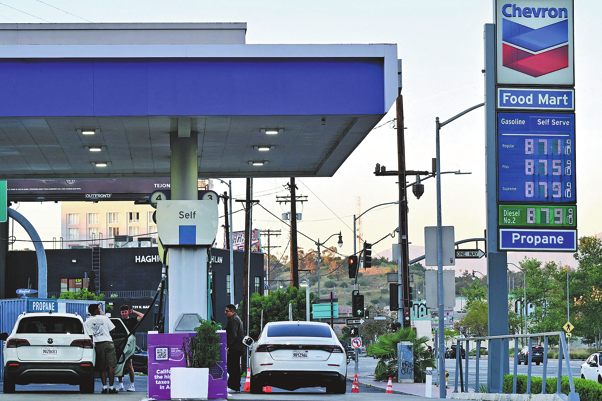
However, domestic shipping companies will be watching for any changes in the Pacific, especially higher costs for fuel amid the oil crisis.
"Anything that gets moved, the price of transportation is going to go up," Robert Kaufmann, an affiliate faculty member of Boston University's Global Development Policy Center and an expert on the world's oil markets, told China Daily.
If supply chain disruptions fully take hold, US consumers will likely have to pay higher prices for clothing, food and travel.
Elahee said: "Freight and shipping costs will begin rising almost simultaneously, initiating a wave of cost increases affecting other sectors of the economy."
Over 20 million barrels of oil were transported through the strait before the conflict began.
Around 90 ships, including oil tankers, have trickled through since the beginning of the tensions, The Associated Press reported on Wednesday.
The strain on shipments to and from the Middle East comes in the wake of the shipping industry coping with snarls on some routes.
From 2023 to 2026, cargo between Europe and Asia via the Red Sea was blocked for two years due to attacks on ships by Yemen's Houthi militia. Many ships were rerouted via Africa's Cape of Good Hope.
The fighting with Iran has highlighted how interconnected the global supply chain is.
Problems in one region are felt in another.
Iran's closure of the strait has led some shipping companies with goods heading for the Gulf to stop shipments to the Middle East altogether and use alternative ports, The Journal reported.
Shortly after the fighting began, airports in the Middle East were also shut, stalling the transit of commercial goods.
"Time-sensitive air cargo shipments for perishable items, already sensitive to delays, are now facing additional costly rerouting as regional airspace in the Middle East remains closed, adding both expense and delay to supply chains where timing is of crucial importance," Elahee said.