China expresses concern over unilateral probes by US
By Wang Keju in Beijing, Zhang Zhouxiang in Geneva and Zheng Wanyin in Paris | chinadaily.com.cn | Updated: 2026-03-16 23:59


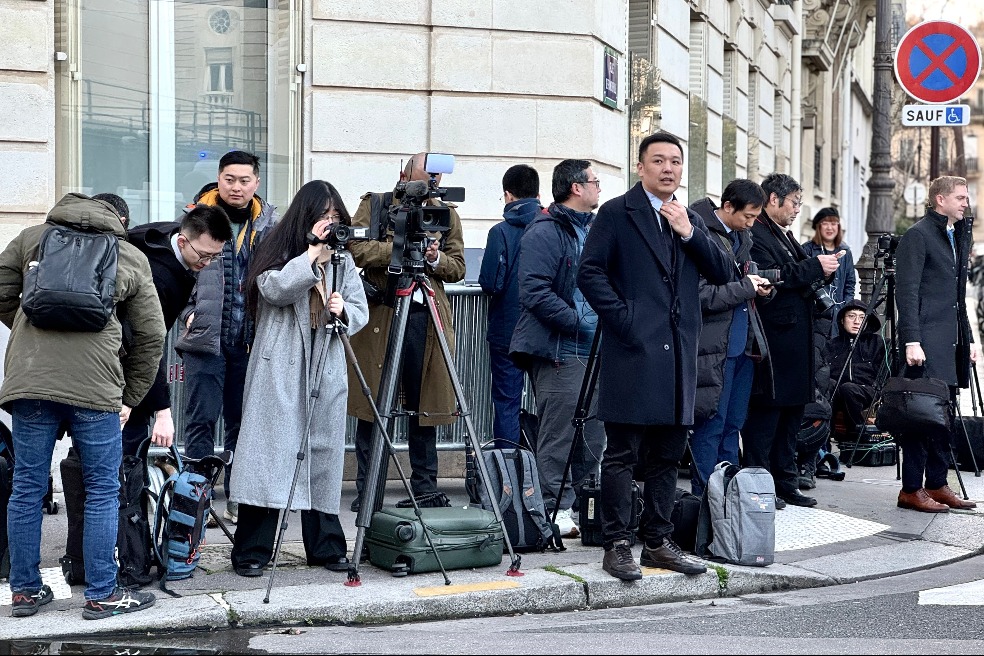
China and the United States discussed the "possible extension" of existing bilateral tariff and non-tariff measures and floated the idea of establishing a working mechanism to promote bilateral trade and investment cooperation during their latest round of trade talks in Paris, France, a senior Chinese official said on Monday.
Describing the one-and-a-half-days of talks as "in-depth, candid and constructive", Li Chenggang, China's international trade representative at the Ministry of Commerce, told reporters that the two sides achieved some "preliminary consensus on certain issues" and will continue to engage in consultations going forward.
Following the conclusion of the sixth round of China-US economic and trade consultations on Monday, Li said that both sides affirmed that "a stable economic and trade relationship serves the interests of both countries and benefits the world".
Regarding the issue of bilateral tariff levels under the new circumstances, Li said the US side explained the latest adjustments to its tariff measures and future considerations. The Chinese side expressed concern over the uncertainty arising from these actions, and both sides affirmed their mutual commitment to maintaining stability in tariff levels, Li added.
To promote bilateral trade and investment cooperation, Li said the two sides discussed the idea of establishing a working mechanism to facilitate such cooperation.
"We jointly reviewed the implementation of the consensus reached during the five rounds of economic and trade consultations last year, and gave a generally positive assessment of the implementation," Li said.
He noted that the two sides also discussed in depth each other's economic and trade concerns.
Li pointed out that the US has continued to introduce a number of restrictive measures targeting Chinese trade and investment. In particular, the US recently launched two separate Section 301 trade investigations, both of which include China.
The Chinese side raised "serious representations" and expressed "grave concern" during the consultations, Li said, to express China's consistent opposition to such unilateral probes.
"We are concerned that the potential outcomes of these investigations could interfere with and undermine the hard-won stability in China-US economic and trade relations," Li said. "We will closely monitor the developments of these investigations and take appropriate measures in due course to safeguard China's legitimate rights and interests."
China hopes the US will honor its commitments, meet China halfway, and work together to promote the steady and sustained growth of bilateral economic and trade ties, Li added.
John Ross, former director of economic and business policy for the mayor of London, said it would be in the interest of the world economy if the US did not pursue a protectionist path, and if it arrived at constructive agreements with China in trade talks.
Liu Zhiqin, senior fellow at Renmin University of China's Chongyang Institute for Financial Studies, said that amid the current complex and ever-changing international trade landscape, only dialogue and consultation offer the best solution for finding a way forward. "China and the US are currently walking this path of consultation. Though the road is long and difficult ahead, there is already a positive beginning," Liu said.
He added that China has plenty of patience, ample confidence, and the strength to engage with the US over the long haul, because "China's market is large enough, its consumer base is robust enough, and its industrial chain is complete enough".
Michael Schumann, chairman of the German Federal Association for Economic Development and Foreign Trade, said that "even a limited understanding between the world's two largest economies can reduce uncertainty for companies that depend on predictable rules and functioning supply chains".
For multinational corporations, the message would be that dialogue remains possible even amid strategic competition, Schumann said, adding that this matters greatly at a time when the global trading system is under pressure.