Wheels of rail governance turn smoothly, invisibly
Expert track work underpins stability, safety during world's largest migration
By Luo Wangshu | China Daily | Updated: 2026-02-24 09:08


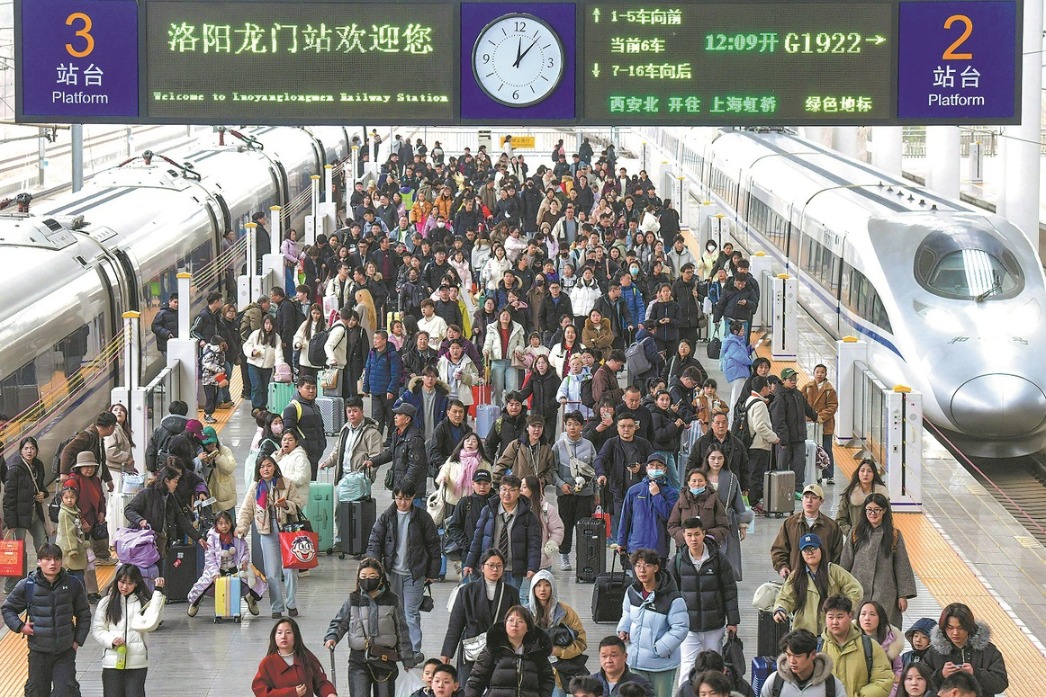
As China's railway system continues to push risk control and operational governance further forward, the annual Spring Festival travel rush remains its most demanding test. The 2026 chunyun period is expected to set new records, with passenger trips projected to reach about 539 million over the 40-day travel season, according to the China State Railway Group. Widely regarded as the world's largest annual human migration, the Spring Festival holiday travel rush has in recent years involved some 9 billion passenger trips across all modes of transport, reflecting both the cultural importance of the holiday and the sheer scale of China's transportation system.
Yet the challenge facing China's railways during chunyun is not simply one of moving more people. It is a test of governance — whether risks can be anticipated, systems coordinated and responses executed before disruptions occur. Each year, the network operates under sustained peak pressure, subjecting infrastructure, personnel and decision-making systems to an intensive but largely invisible stress test.
System stress test
For China's railways, the Spring Festival holiday period represents the most demanding operating conditions of the year. Passenger volumes surge, maintenance windows shrink and operational margins narrow across the network. Unlike ordinary peak seasons, the holiday rush stretches the limits of the system to the utmost for an extended period, increasing the potential for small disruptions to cascade across regions.
Railway engineers often describe chunyun operations as an "extreme operating state". Passenger services increase sharply while freight trains continue to run on tight schedules, leaving little room for error. The task is not simply to dispatch more trains, but to ensure that a highly complex system continues to function reliably under sustained stress.
Much of the work that supports Spring Festival operations takes place out of public view. At night, when passenger services pause briefly, maintenance teams enter tightly scheduled "window periods" to inspect tracks, tunnels and critical structures. Many inspections are conducted underground or in remote locations, where access itself requires careful planning and coordination.
In Beijing, a young team of high-speed rail track grinders, mostly in their early 20s, takes on some of the most precise maintenance tasks. On cold, dark mornings before dawn, sparks fly as the workers push their 200-kilogram grinding machines along the tracks, smoothing microscopic irregularities in the steel rails. "These tiny 'skin problems', sometimes smaller than a millimeter, directly affect train stability and passenger comfort. We have to fix them before they become serious," said Liu Qiang, the team leader. Each night, the eight-member team walks nearly 6 kilometers while grinding tracks, completing up to 50 back-and-forth passes in their designated section.
This work, though largely unseen, is crucial to maintaining the smooth, stable rides high-speed passengers expect.
When the train is running at 350 km per hour, a cup of water shouldn't wobble, a coin shouldn't fall. "Our team's precision makes that possible," said Xu Leigang, an engineer from the Beijing high-speed rail maintenance department with the China Railway Beijing Group.
Critical maintenance
Similar inspections continue across the network under far more demanding environmental conditions. In northern regions, winter temperatures can fall below minus 20 C. Rail inspection teams conduct routine overnight checks using ultrasonic testing equipment to detect internal flaws in steel rails — defects invisible on the surface but capable of worsening rapidly under low temperatures and repeated loading.
Along the Beijing-Harbin high-speed railway near Chengde in Hebei province, inspectors scan rail tracks section by section as train frequency increases during the Spring Festival holiday period. "Cold temperatures change how steel behaves," said engineer Liu Zhengyang. "Identifying internal risks early allows maintenance to be scheduled before they affect operations."
By treating winter conditions as a normal operating parameter rather than an emergency scenario, railway authorities aim to reduce uncertainty during the busiest travel period of the year. The work of the grinding teams exemplifies this philosophy: they combine skill, precision, and new technology to anticipate problems before they disrupt services.
Some of the most complex maintenance work takes place inside long mountain tunnels, where access is limited and environmental conditions vary sharply. On the Beijing–Hong Kong high-speed railway, the Wan'an tunnel extends nearly 14 km through the hills of southern Jiangxi province. After the final train passes at night, inspection teams enter through designated access shafts, following established safety protocols for ventilation, communication and emergency response.
Within narrow maintenance windows, crews inspect electrical systems, structural linings and drainage facilities. Groundwater management remains a persistent concern. "Water management requires continuous intervention," said maintenance worker Yan Junliang. "The objective is to address issues before they affect equipment or train operations." By integrating such inspections into routine maintenance cycles, railway operators aim to prevent small structural issues from escalating under peak traffic conditions.
A defining feature of modern railway operations is the effort to move risk control as far forward as possible. Rather than relying on post-failure repairs, railway authorities increasingly emphasize early warning and preventive maintenance. Real-time monitoring systems track changes in track alignment, bridge stress and equipment performance, enabling engineers to intervene before minor irregularities develop into operational disruptions.
On major high-speed corridors, maintenance teams use night windows to fine-tune track conditions with millimeter-level accuracy. For large bridges and other critical structures, long-term monitoring data supports continuous assessment of structural condition, supplementing routine visual inspections. The story of Liu Qiang and his team illustrates how human skill and technology converge to maintain system reliability. "It's cold, it's tiring, but knowing that our work keeps passengers comfortable and safe makes it worthwhile," Liu said.
Inside railway dispatch and command centers, workers monitor large volumes of operational data throughout the Spring Festival holiday period. Equipment performance indicators, traffic flows and system alerts are reviewed continuously to identify anomalies that may signal emerging risks. "Most technical issues leave patterns in the data before they become visible on the ground," said Song Fang, a dispatcher from China Railway Chengdu Group. "Our role is to identify those signals early enough for intervention to remain routine."
Extreme weather
Winter weather adds another layer of complexity to Spring Festival operations, particularly in mountainous and western regions. Along sections of the Sichuan-Qinghai railway, maintenance crews conduct scheduled inspections of communication and power supply systems in snow-covered terrain. High-altitude towers and overhead equipment are checked according to standardized procedures for cold-weather and high-altitude operations. Rather than treating snow and ice as exceptional disruptions, railway authorities incorporate winter maintenance into regular operating plans, managing weather-related risks as part of routine system governance rather than emergency response.
While skilled railway personnel remain essential to Spring Festival operations, the system increasingly relies on structured coordination rather than individual endurance alone. Monitoring technologies extend human perception, standardized procedures guide decision-making, and redundancy reduces dependence on last-minute intervention. Human expertise functions within an integrated framework designed to operate reliably under peak stress.
For most travelers, Spring Festival rail journeys are measured in departure times and ticket availability. Largely unseen is the continuous testing of infrastructure, coordination and risk management that makes those journeys possible. Each year, the Spring Festival holiday travel rush serves as a quiet examination of the railway system's governance capacity. That trains continue to run smoothly under extreme demand is not the result of improvisation, but of systems designed to anticipate pressure and manage it before it becomes visible. In that sense, the steady movement of trains during the holiday season reflects not only transport capacity, but also the ability of complex public systems to function reliably at scale — consistently, predictably and largely out of sight.