Marine fragility turned into opportunity
By Vincent Meriton | China Daily Global | Updated: 2026-10-29 09:41


In March 2020, Seychelles accomplished what many larger nations have still not managed: We placed 30 percent of our national waters under formal legal protection, an expanse of ocean larger than Germany. We did this not because we could afford it, but because we couldn't afford not to.
This year marks the 50th anniversary of diplomatic relations between Seychelles and China, which began in June 1976, just one day after our independence. I want to use this occasion to tell a story of transformation: how a nation of roughly 120,000 people, spread across 115 islands in the Indian Ocean, has turned fragility into opportunity and leverage, and why this lesson matters to the world.
From the first settlers in 1770 to the Seychellois of today, the sea has been a constant presence in our lives, feeding us, employing us and shaping our identity. Our dependence is evident in the tuna we catch and export, the tourists who dive in our reefs and the fact that almost everything we consume arrives by ship.
What is less obvious is how vital the ocean is to everyone else as well.
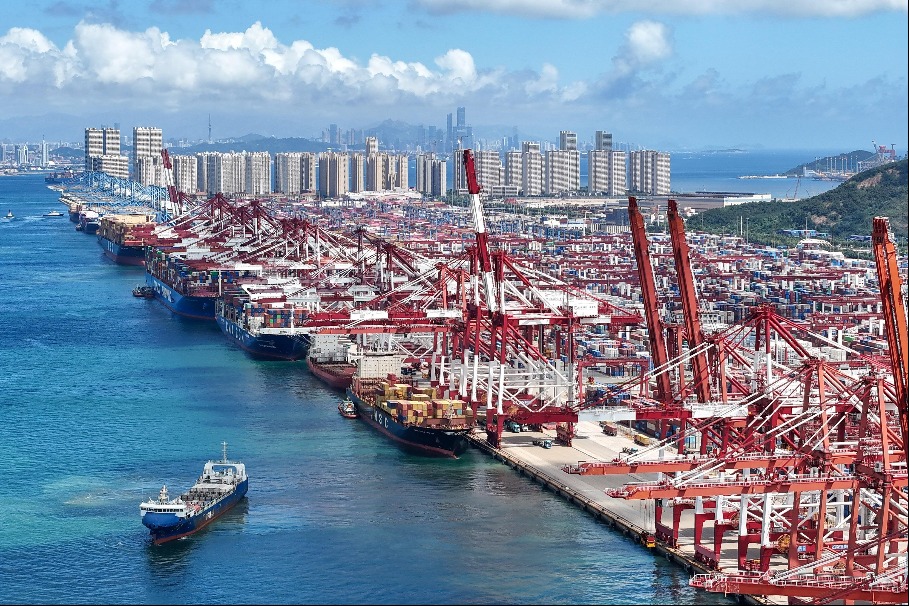
Humanity's next frontier for sustainable growth lies in the sea. While continents divide us, it is the ocean that binds us together, touching every inhabited coast and carrying roughly 80 percent of global trade. The ocean is a critical climate regulator, absorbing roughly 90 percent of the excess heat and about a third of carbon dioxide emissions. It also generates half the world's oxygen and provides around a fifth of the animal protein for over 3 billion people. Yet we often treat this vital system as an afterthought. We have mapped more than 98 percent of the moon's surface in high resolution but only 28.7 percent of our own ocean floor has been mapped to the same standard.
As a nation shaped by the sea, Seychelles has had no choice but to address this global oversight. For island nations, the ocean is the front line of economic and ecological vulnerabilities. We face a narrow economic base reliant on tourism and fisheries, exposure to climate shocks we didn't cause, and susceptibility to global supply disruptions.
For generations, the conventional assessment was that geography had dealt small island nations a weak hand.
But we chose to rewrite that narrative. While our landmass is small, our sovereign maritime territory is immense, spanning 1.4 million square kilometers and giving us one of the largest ocean-to-land ratios in the world. Our diplomats at the United Nations have championed the reframing of our identity from "small island states" to "large ocean states". The challenge was never a lack of natural assets but the difficulty of establishing the institutional capacity and innovative financing required to manage them responsibly.
This philosophy has guided our policies over the past decade. In 2016, Seychelles launched the world's first blue economy debt-for-nature swap, restructuring $21.6 million of sovereign debt to directly fund marine conservation. In 2018, we issued the world's first sovereign blue bond, raising $15 million from international investors with backing from the World Bank to rebuild sustainable fisheries. These initiatives were sophisticated fiscal instruments engineered to value, protect and manage our marine ecosystems.
However, though we can conceive groundbreaking policies, we lack the infrastructure for execution — the deep-sea research vessels, high-resolution satellite arrays and advanced marine engineering that modern oceanography demands.
This is where our strategic partnership with China has proved vital. In marine science, China has been an active partner in a shared global mission. This collaboration has already yielded concrete economic and scientific milestones. Following a bilateral fisheries agreement, Seychelles' seafood exports to China increased eightfold. This commercial pipeline expanded further after China's zero-tariff policy for goods from all African countries with diplomatic ties to China took effect in May, reducing in-quota tariffs to zero on a wide range of our exports.
Beyond trade, our marine scientists are now working alongside China's National Deep Sea Center and the Ocean Decade International Cooperation Center, accessing deep-sea research capabilities that an island nation could never develop independently. A major milestone is the upcoming 2027 East African Ocean Exploration Cruise, scheduled to be launched from Port Victoria. For the first time, the scientific data and ecological discoveries generated by a major international expedition will originate from our doorstep, positioning Seychelles as a genuine research architect.
This is the enduring insight we offer to the global community on this anniversary: fragility, when managed with honesty and innovation, is not the antithesis of opportunity; it is often its origin. China's willingness to engage with Seychelles as an equal interlocutor in ocean governance and marine science is the most meaningful expression of our 50-year friendship. It is my profound hope that the next 50 years will afford other large ocean states the same opportunity to be engaged — not for what they lack, but for the vital insights they have already gained.
The author is a former vice-president of the Republic of Seychelles.
The views do not necessarily reflect those of China Daily.
If you have a specific expertise, or would like to share your thought about our stories, then send us your writings at opinion@chinadaily.com.cn, and comment@chinadaily.com.cn.




Editor's Pick