DPP secessionists brazenly exploit disaster as political prop
By Li Yang | chinadaily.com.cn | Updated: 2026-08-28 23:34


There is something especially revealing about politicians who seek to exploit a natural disaster for political gain.
After the catastrophic landslide and flash flood that struck Nepal and China's Xizang autonomous region this week, causing heavy casualties, some secessionist-minded officials of Democratic Progressive Party authorities of China's Taiwan region, including Hsiao Bi-khim and Wu Chao-hsieh sought to capitalize on it.
In their so-called "condolences", they framed the disaster as being at the "Tibet-Nepal border", studiously avoiding any mention of the fact that Xizang is part of China. The wording may look "innocuous" to the casual reader. But it is anything but innocuous. For officials associated with a party whose political project is deeply entangled with separatist thinking, the omission is the message.
What came next was even more grotesque: A pro-DPP media outlet reportedly claimed that Nepal's disaster relief efforts were delayed because "the mainland gave no early warning".
Really?
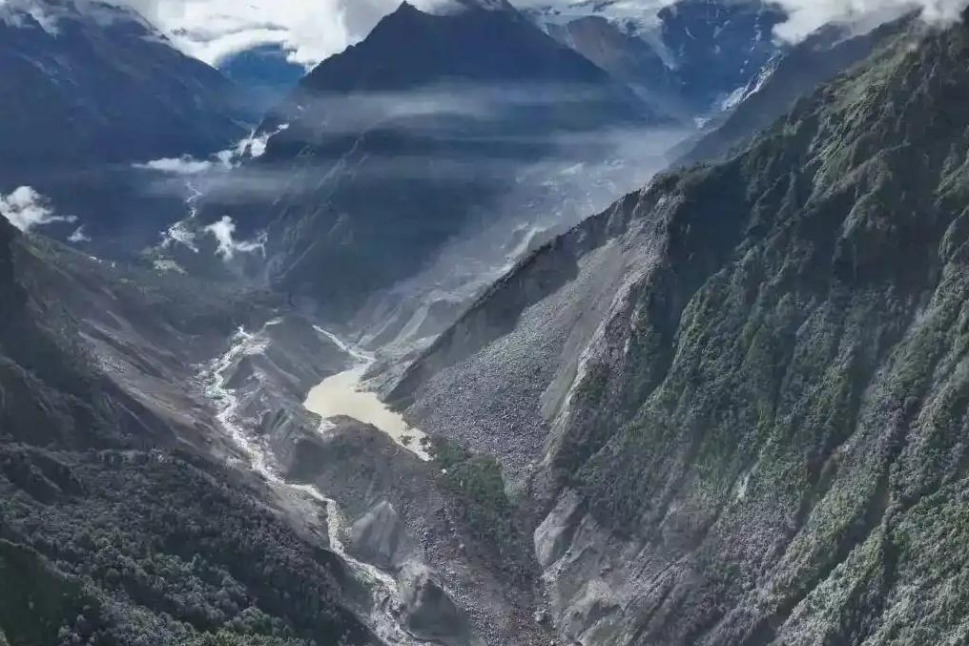
Scientific evidence points to a cascading geophysical disaster that began on the Nepalese side. A high-altitude glacier collapse sent ice and rock down the mountain, picking up huge quantities of loose debris and eventually generating a devastating mudslide that struck Gyirong Port in Xizang.
Experts have emphasized how little reaction time was available. The flow traveled at roughly 50 meters per second, covering nearly 14 miles in just 6 minutes and 50 seconds, leaving virtually no time to react.
The United States Geological Survey later confirmed there was no earthquake involved and the event was "a glacial collapse and debris flow" that "caused subsequent catastrophic impacts downstream".
Yet somehow a natural catastrophe becomes, in the pro-DPP media outlet's telling, another indictment of Beijing.
Scientists have warned that rising temperatures are destabilizing glaciers, permafrost and high-altitude slopes, increasing the risk of cascading hazards in the Himalayas. The climate crisis is a global challenge, not a convenient accusation to be hurled across the Taiwan Strait.
This is what happens when ideology overrides compassion.
Beijing's response to the disaster was swift. Authorities activated emergency responses, mobilized the military, firefighting and specialist rescue teams, deployed helicopters, drones and heavy equipment, and coordinated with Nepal on search-and-rescue operations.
Beijing also said it was prepared to provide emergency assistance according to Kathmandu's needs.
Many foreign leaders and international organization chiefs, including UN Secretary-General Antonio Guterres, have expressed grief over the loss of life in both Nepal and China, while the UN said humanitarian partners were supporting relief operations in the two countries. The Taiwan secessionists' response is to turn a landslide into a despicable political spectacle.
The UN's disaster-risk chief later described the catastrophe as a reminder of the "transboundary nature" of disaster risks and the fragility of mountain ecosystems.
Hsiao and Wu may believe that carefully deleting the word "China" makes a political point. It does. It tells grieving families that even in death, tragedy serves ideology for the secessionists of the DPP authorities.
The pro-DPP media outlet, with its ugly performance, has also exposed its true colors as a political tool of the DPP authorities. One that is always ready to stoop to new lows in spreading fake news.
The DPP authorities' brazen attempt to smuggle their separatist agenda into a disaster zone and shamelessly pretend it is compassion has been denounced by people on both sides of the Strait.
The DPP's politicization of this tragedy runs counter to the true feelings of compatriots on the island. While firmly opposing the DPP authorities' separatist opportunism, it should be acknowledged that people on both sides of the Strait have always stood together in times of disaster.
A glacier collapsed. Rivers surged. Mud buried lives. But for some Taiwan secessionists that is free publicity for their cause, not a tragedy to be lamented.





Editor's Pick