A shared future for AI begins with shared governance










Artificial intelligence is no longer a technology of tomorrow. It is rapidly becoming the operating system of today's global economy, transforming industries, reshaping societies and redefining how humanity confronts challenges ranging from climate change and healthcare to education and disaster prevention.
Yet as AI's capabilities accelerate, so do questions about security, ethics, inequality and governance. The world now faces a defining choice: whether AI will deepen existing divisions or become a force for common prosperity.
Against this backdrop, China offers a timely and comprehensive vision for building a fair, inclusive and effective global AI governance framework. Rather than treating AI merely as a contest for technological supremacy, China has placed the discussion where it belongs — on humanity's shared future.
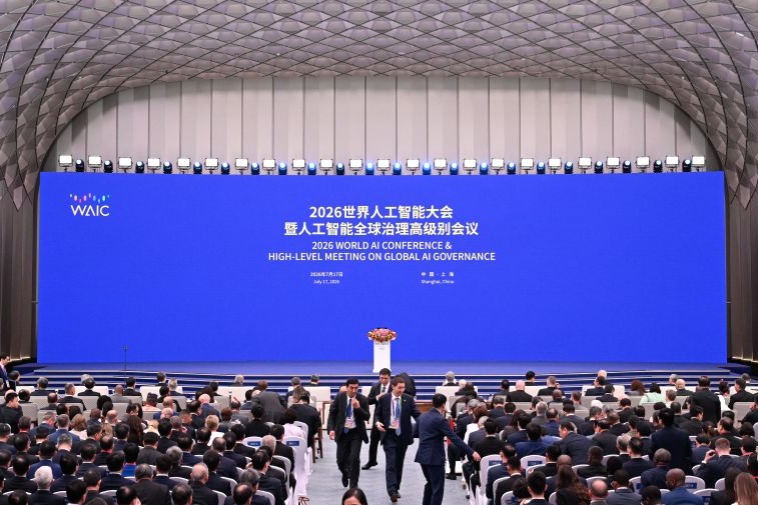
The World Artificial Intelligence Conference, held in Shanghai under the theme "AI Partnership for a Brighter Future", reflects an increasingly important reality: no nation, regardless of its technological strength, can independently govern a technology whose influence transcends borders. Algorithms travel faster than regulations. Digital risks ignore geography. The benefits of AI should therefore be matched by equally global mechanisms of cooperation.
China's proposal begins with a simple yet profound principle: AI should remain people-centered and serve the common good. Technology should enhance human dignity, improve livelihoods and create opportunities rather than widen inequalities or fuel confrontation. This philosophy provides a moral compass at a time when commercial competition and geopolitical rivalry often threaten to overshadow the public interest.
Building upon this principle, China has outlined four mutually reinforcing pillars for global AI governance: openness and shared innovation, security and responsible development, inclusiveness and mutual learning among civilizations, and solidarity and global governance. Together, these principles form not merely a diplomatic statement but a practical governance architecture capable of addressing both the opportunities and challenges presented by AI.
Innovation flourishes most effectively in an environment of openness rather than isolation. Scientific discovery has always advanced through collaboration, knowledge exchange and shared progress. Artificial intelligence should be no exception. Encouraging open-source development, expanding international research cooperation and promoting wider technological applications can help ensure that AI becomes an engine of global growth rather than another source of technological fragmentation.
At the same time, rapid innovation must be accompanied by robust safeguards. AI should remain a trustworthy tool that operates under meaningful human oversight. Effective governance requires legal frameworks, technical monitoring, risk assessment and emergency response mechanisms that evolve alongside technological progress. Such safeguards should protect societies without unnecessarily restricting innovation or allowing security concerns to become barriers to legitimate international cooperation.
Equally significant is China's emphasis on cultural diversity. Artificial intelligence should not become a vehicle for imposing a single set of cultural values upon the world. Instead, AI should facilitate dialogue among civilizations, preserve linguistic and cultural diversity, and promote mutual understanding. Technology should enrich humanity's diversity rather than diminish it.
Perhaps the most distinctive feature of China's proposal is its commitment to narrowing the global intelligence divide. While AI has generated enormous opportunities, it has also highlighted significant disparities in computing resources, technical expertise and governance capacity between developed and developing countries. Without deliberate international action, these gaps risk becoming permanent structural inequalities.
China's latest initiatives directly address this challenge through concrete action rather than abstract aspiration. Over the next five years, China will provide 5,000 specialized AI training opportunities for participants from developing countries, helping cultivate local expertise in technology, governance and ethical regulation. Regional AI application cooperation centers will be established with ASEAN, the African Union, the Arab League, the Community of Latin American and Caribbean States, the Shanghai Cooperation Organization and BRICS countries, enabling AI solutions to better serve regional development priorities.
Another practical contribution is the international rollout of the MAZU intelligent meteorological early-warning system. Combining advanced AI forecasting models with satellite observation capabilities, the platform supports disaster preparedness, climate adaptation and public safety. By extending such public-interest technologies to more countries, AI becomes not simply an innovation for commercial gain but a global public good capable of protecting lives and supporting sustainable development.
Institutionally, China's proposal has also entered a new stage with the establishment of the World Artificial Intelligence Cooperation Organization. By creating an inclusive intergovernmental platform for dialogue, standards coordination, capacity building and risk governance, the organization represents an important step toward more representative global AI governance. It offers developing countries greater opportunities to participate in shaping international norms, ensuring that AI governance reflects the interests of the broader international community rather than a limited group of technological powers.
Equally important is China's consistent support for the United Nations as the primary platform for global AI governance. Complex global technologies require genuinely multilateral solutions. International rules should emerge through consultation, mutual respect and consensus rather than unilateral decision-making. Strengthening the UN's coordinating role will help ensure that AI governance remains open, transparent and broadly representative.
The significance of China's approach extends beyond technology itself. It reflects a broader vision of international cooperation based on equality, shared responsibility and mutual benefit. In an era marked by increasing geopolitical uncertainty, AI governance should not become another arena for strategic rivalry. Instead, it should demonstrate that even amid competition, humanity remains capable of cooperating in pursuit of common interests.
History shows that transformative technologies ultimately reshape not only economies but also international institutions. Artificial intelligence now presents a similar moment of historic significance. Whether it becomes a source of greater division or greater solidarity will depend largely on the governance choices made today.
As AI continues to evolve at extraordinary speed, its direction matters as much as its capability. Governance must keep pace with innovation. Ethics must guide algorithms. Cooperation must prevail over confrontation.
Artificial intelligence should never become the privilege of a few. It should remain a shared achievement of humanity and a force that advances peace, development and common prosperity.
By advocating openness instead of exclusivity, inclusion instead of division, and cooperation instead of confrontation, China's vision contributes constructive ideas and practical pathways toward building a fairer and more balanced global AI governance system.
The future of artificial intelligence belongs to all humanity. Building that future requires not only smarter machines, but also wiser global governance.
Xu Ying is a Beijing-based commentator.
The views don't necessarily reflect those of China Daily.
If you have a specific expertise, or would like to share your thought about our stories, then send us your writings at opinion@chinadaily.com.cn, and comment@chinadaily.com.cn.