Beloved opera flowers again
Three years after its premiere, The Wild Rhododendron returns with fresh emotional depth, Chen Nan reports.
By Chen Nan | China Daily | Updated: 2026-07-02 06:29


In a rehearsal room at the National Centre for the Performing Arts in Beijing, a familiar melody rises — a tune that has lived in the memories of generations of Chinese audiences.
"Little bamboo raft drifting on the river, towering green mountains moving along the banks …"
As tenor Wang Hongwei begins to sing The Red Star Guides My Journey, the song seems to unlock a door to the past. For many in the room, the melody is more than music; it is a reminder of childhood, of a beloved story passed down through families, and of a time when cinema and theater shaped the imagination of millions.
The years appear to fade away. A classic story returns, carrying both the emotions of the past and a new meaning for the present.
Despite the exhaustion of traveling between Beijing and Tianjin and a voice marked by a demanding schedule, Wang, 58, the president of the Tianjin Conservatory of Music, quickly steps back into the world of the stage. His portrayal of Pan Xingyi — a father, a soldier and a man driven by conviction — once again carries the warmth, courage and determination that have defined the character.
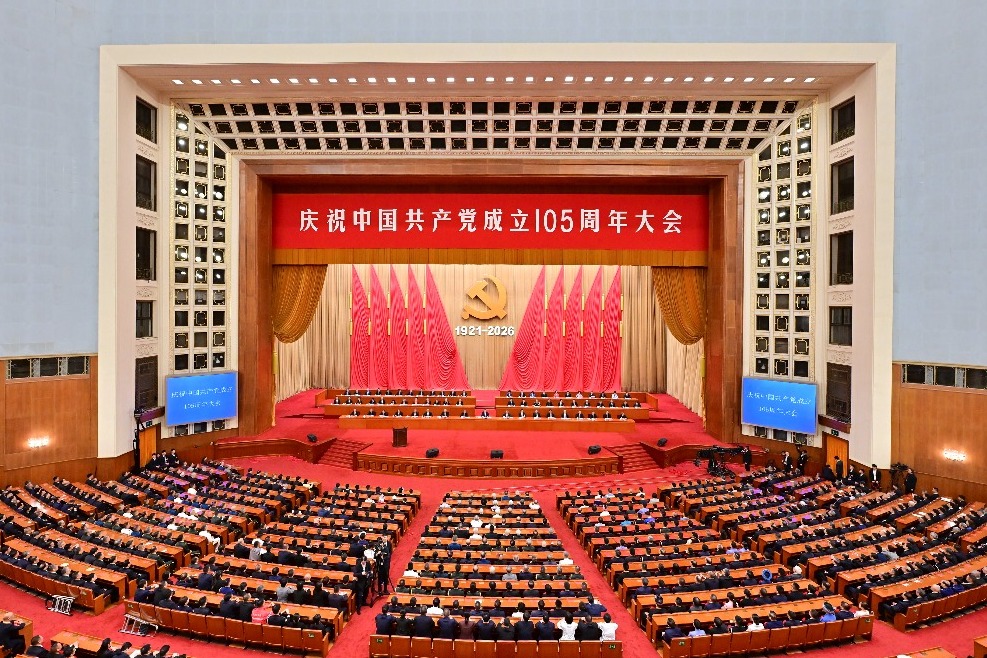
The moment captures the emotional power behind The Wild Rhododendron, of which the song is a part. The original Chinese opera by the National Centre for the Performing Arts returns from July 1 to 4, marking the 105th anniversary of the founding of the Communist Party of China.
Adapted from Li Xintian's classic novel Sparkling Red Star, the opera revisits a story deeply embedded in Chinese cultural memory.
The original novel, first published in the 1970s, became widely known after it was adapted into a film by the August First Film Studio in 1974. Its young hero, Pan Dongzi, became one of the most recognizable childhood figures for generations of Chinese audiences, while the movie's soundtrack also captured their hearts.
The Chinese opera, which premiered in 2023, reimagines the story through music and a more intimate dramatic lens. Composer Zhang Qianyi created the score, while Fu Gengchen — composer for the famous film adaptation — was invited as music adviser, linking the new production with the cultural memory of the earlier work.
At the center of the story is young Pan Dongzi, whose father, Pan Xingyi, joins the Red Army during a time of conflict and leaves his son a small red star — a symbol that becomes a guiding force throughout his life.
But the Chinese opera shifts its emotional focus beyond the boy hero. It brings a new figure to the foreground: Dongzi's mother, an ordinary village woman whose transformation from wife and mother into a courageous revolutionary becomes the heart of the story.
This revival is not simply the return of an old production. It is an attempt to rediscover a classic through a new perspective.

For Wang Hongwei, returning to the role of Pan Xingyi after three years has changed the way he understands the character.
"The character has become closer to me, and more personal," he says."A great role requires time to settle and mature."
Wang believes that distance has allowed him to discover new layers in the role — not only through technique, but through his own experiences as a performer.
The new production strengthens the relationships between the characters. Earlier versions focused more on musical storytelling, but this revival expands the emotional exchanges between Pan Xingyi, Pan Dongzi's mother and their son.
One of the most important changes is a farewell scene between the husband and wife. Originally written as a solo aria, it has been transformed into a duet, allowing the audience to feel the weight of their separation more deeply.
"The story is no longer just a sequence of beautiful music," Wang says. "It has stronger tension, deeper meaning and greater emotional movement."
The opera opens in 1934, when Pan Xingyi prepares to leave with the Red Army. Before dawn, Pan Dongzi's mother makes straw sandals and packs supplies for her husband. Their farewell is quiet, filled with the sorrow of a family that understands separation may be permanent.
Before leaving, Pan Xingyi gives his young son the red star.
That small object becomes the beginning of Pan Dongzi's journey.
After the army withdraws, a returning landlord and his militia bring fear to the village. Facing violence and oppression, Pan Dongzi's mother joins the villagers' resistance.
At the same time, the Red Army struggles through the Long March (1934-36), crossing snow-covered mountains and vast grasslands, while underground fighters continue their battles in the forests.
These two journeys — one across battlefields and mountains, the other through the courage of ordinary villagers — reveal the opera's central idea: history is shaped not only by famous figures, but also by countless individuals who choose courage when faced with impossible choices.
"Dongzi's mother is not born a hero," says soprano Wang Zhe, who plays the role. "She becomes one through her experiences, through responsibility, and through the choices she makes."
Her final sacrifice becomes the opera's emotional climax. When a secret gathering is discovered, she risks her life to protect others, drawing the enemy away and sacrificing herself.

The flames that take her life later transform into a vision of blooming rhododendrons — the flower that inspires the opera's title.
The boy who once watched his parents leave grows into a young soldier, moving forward beneath the imagined light of the red star.
For Wang Hongwei, performing The Wild Rhododendron is also a conversation with the past.
"Classics already exist before us," he says. "But our generation has its own understanding. Our voices, techniques and life experiences are different from decades ago."
He hopes to bring something personal to Pan Xingyi — not only the history of the character, but also the emotions of an artist who has spent a lifetime on stage.
In recent years, Wang Hongwei, as an educator, has also explored how history and revolution-themed works can connect with younger audiences. For him, such operas are not simply performances.
"They are a kind of inheritance," he says. "Through art, we bring people closer to history and closer to the heroes who came before."
Related Stories





Editor's Pick