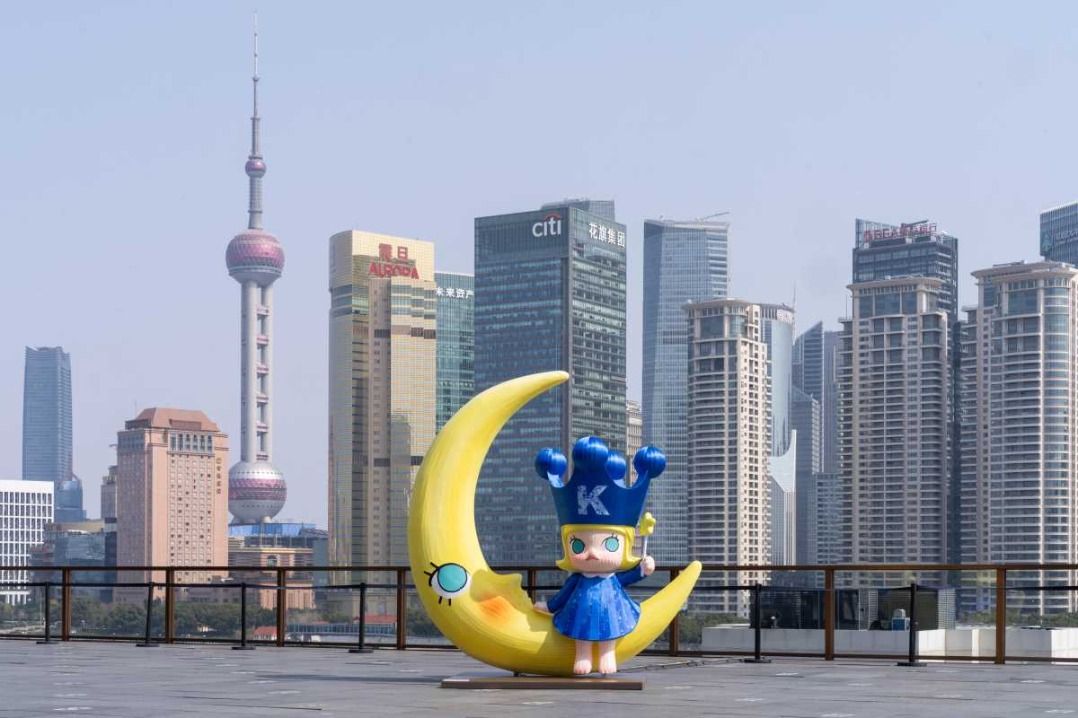
Shanghai outlines plan for service industry development
As economic pillar, city saw sector's added value reach 4.5 trln yuan in 2025
By SHI JING in Shanghai | China Daily | Updated: 2026-06-15 09:15


While the service industry has already been an important growth engine for Shanghai, it is expected to play a bigger role in the next few years as the city responds to changes in consumption patterns and embraces the surge of new technologies, said officials and experts.
Their comments came as the city released its 15th Five-Year Plan (2026-30) for the service industry on June 1.
As a major economic pillar in Shanghai, the service industry saw its added value reach 4.5 trillion yuan ($664.65 billion) last year, accounting for 79.3 percent of the city's GDP. According to the new plan, the service industry should evolve into a resilient economic foundation with higher capacity as well as a centerpiece connecting more global resources.
The target average annual growth rate of value added in the service industry is at least 5.5 percent by 2030, with labor productivity exceeding 450,000 yuan per capita.
"Shanghai no longer defines the service industry as the tertiary industry in a conventional way. The municipal government not only cares about industry value, but attaches more importance to the systematic layout of service functions and innovation capabilities. The industry will be the core to further elevate Shanghai's competitiveness in the next five years," said Zhang Yina, deputy head of the School of Social Development and Public Policy at Fudan University.
One highlight of the latest plan is the forward-looking arrangement for emerging service sectors covering intelligent technologies, life sciences and health, and the experience economy. Specifically, Shanghai aims to deepen the development of artificial intelligence software technology and services, intelligent driving, targeted drugs, brain-computer interfaces, as well as new experience-based economy services such as immersive cultural tourism and IP consumption, according to the new plan.
"This step forward is mainly because the service industry nowadays is no longer limited to person-to-person. It has become more comprehensive by integrating AI agents and the experience-based economy. The digital economy, biomedicine and healthcare are now part of the service industry," she said.
The integration of services into other economic sectors is also reflected in the city's goals for the financial industry, as the plan has embedded growth targets for cross-border payment and pension finance. This can make the service industry the true cornerstone of the city's key functions, according to Zhang.
Another major step forward as depicted in the new plan is the upgrading of consumer services, which were regarded as livelihood support in the past. The latest plan has upgraded them as the new engines to further boost consumption and economic growth, said Zhang.
One specific example is that Shanghai aims to cultivate two to three leading domestic service providers featuring larger market influence, well-established brands and complete service systems during the 15th Five-Year Plan period, according to Liu Min, deputy director of the Shanghai Municipal Commission of Commerce.
In 2025, Shanghai announced its first batch of 16 domestic service enterprises with an employee-based management model to better regulate the industry. The city is likely to roll out the revised version of the regulations for domestic services at the end of this year, she added.
These will largely address the difficulty of finding the right domestic helper, which is a huge headache for many local residents, said Liu.
The new plan has also set an independent part for the development of the cultural, commercial, tourism, sports and exhibition industries, underscoring the integration of traditional shopping and experience economy.
According to Neo Huang, head of retail for Jones Lang LaSalle East China, new consumption trends will be nurtured by the rise of the digital and intelligent economy, quality of life, rational consumption and emotional value. New space demand will thus be derived in the retailing industry.
Meanwhile, service consumption is expected to grow at a faster pace, injecting new growth momentum into the entire consumption sector. Consumers will gradually make the transition from purchasing products to paying more for experiences and services. The service demand in cultural activities, entertainment and sports is expected to be further released, he said.
Huang's prediction does not come from nowhere. Data from the municipal government show that the number of large-scale events with over 1,000 participants held in Shanghai in 2025 increased 34 percent year-on-year. The total number of visitors and tourists that the city received last year increased by 21 percent on a yearly basis, with inbound tourists surging by nearly 40 percent.
Industrial services are also a key focus in the next five years, as the city aims to expand the application scenarios, strengthen the service industrial chains and build larger industrial clusters, according to Ge Dongbo, deputy director of the Shanghai Municipal Commission of Economy and Informatization.
shijing@chinadaily.com.cn
Related Stories






Editor's Pick