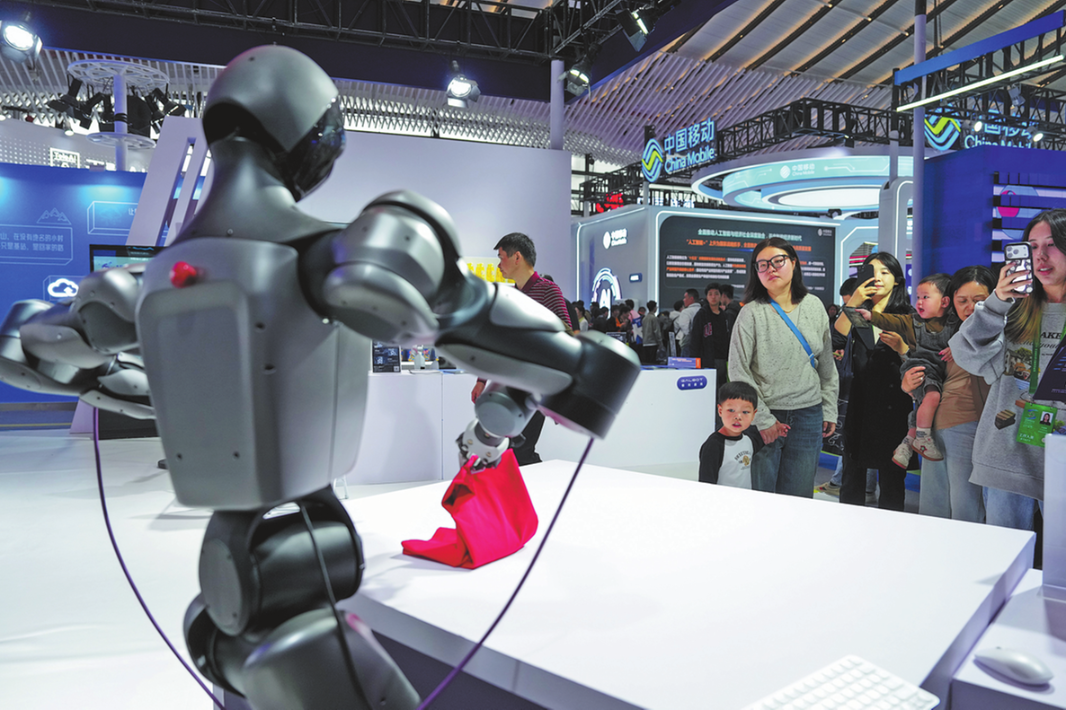
Artificial intelligence helps seniors adapt to digital age
By Li Lei | China Daily | Updated: 2026-03-04 19:58


China's breakneck digitalization has had a sad subplot: the generational divide. Elderly patients waited in line at hospital windows while younger patients booked online appointments from home. During the COVID-19 pandemic, many found themselves unable to access public places, as health codes and QR code scans — both of which required smartphone registration — became mandatory at every entrance.
Government initiatives to maintain cash payments and manual counters offered some relief in the rapidly established cashless society, but the "digital divide" still seemed an inevitable price of progress.
However, something remarkable is happening. China's AI development is helping those previously sidelined in the internet age to finally catch up.
During the Spring Festival holiday last month, millions of urban professionals returned to their hometowns expecting to serve as tech support for baffled parents. Instead, they found mothers and fathers not only using AI chatbots like Doubao, but teaching their children new tricks. My former professor in Xi'an, Shaanxi province, now uses AI to polish his bilingual social media posts, research historical sites during travels, and decode medication instructions. "It never argues with you," he told me with a laugh — a small comfort, he added, with his only daughter working far away in Beijing.
The pivot is no accident. AI assistants possess features that the less tech-savvy find more accessible. Voice input eliminates the need to type on tiny keyboards. Read-aloud functions bypass poor eyesight or literacy challenges. Conversational interfaces feel less like operating a machine and more like asking a patient friend for help. For seniors who found smartphones bewildering, talking to an AI assistant feels natural.
This marks a fundamental shift from the mobile internet era, which often excluded the elderly. The learning curve was steep; the shame of asking younger people — already impatient from busy work schedules — for help was steeper. AI's "infinite patience", as one Beijing-based AI trainer described it, removes that emotional friction.
China's policymakers recognized the problem early. A 2023 law on building a barrier-free environment, the first of its kind in China, explicitly mandates accessible information access for the elderly, requiring government websites and public service platforms to accommodate their needs.
The Ministry of Industry and Information Technology has pushed thousands of apps to launch "senior modes" with simplified interfaces and larger text. By 2025, over 3,000 websites and apps had completed the revamp.
But AI is achieving what regulation and redesigned apps could not: it is making technology genuinely intuitive. Adoption among seniors is accelerating through family networks, not government mandates — word-of-mouth in WeChat groups is proving more powerful than any public service announcement.
Yet risks remain. A 2025 study by Shanghai Jiao Tong University found persistent "literacy gaps" between generations, with nearly one-third of users — young and old alike — almost completely unaware that AI can fabricate information with complete confidence. My former professor learned this the hard way when Doubao misspelled a famous local merchant's name in his post, drawing embarrassing corrections from followers. Access, the lesson suggests, must be paired with digital literacy.
Yet, a technology often feared for its potential to displace jobs is proving unexpectedly adept at inclusion. China's elderly, once left on the platform watching the digital train depart, are finally finding a seat. The destination is a society where "digital divide" becomes a historical term, and where 310 million senior Chinese citizens can navigate the future with confidence — and a little help from their AI friends.
Photo