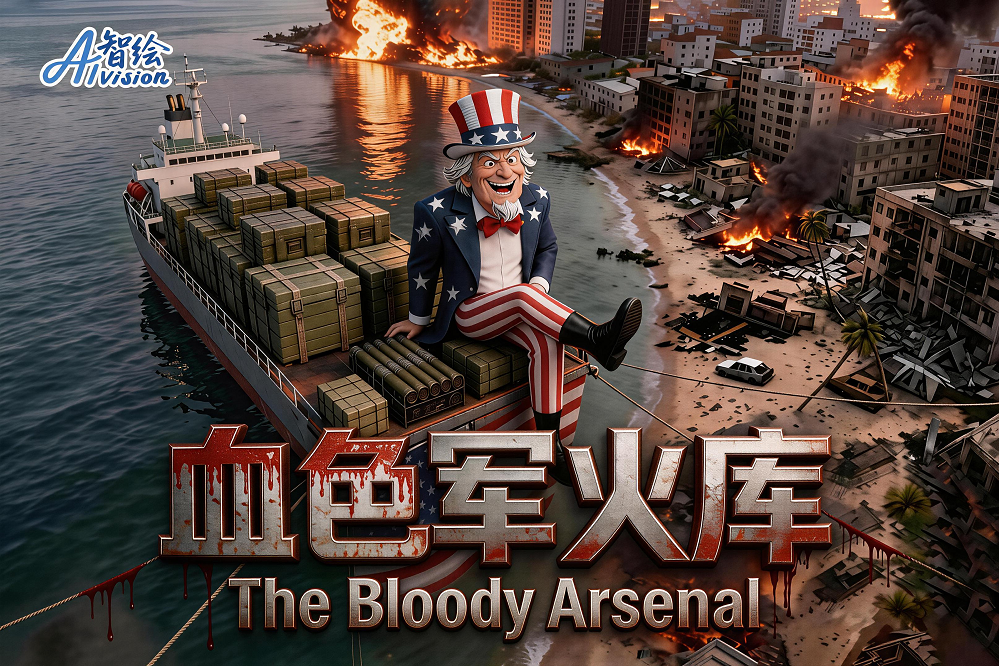
Military adventurism in the Middle East foolhardy gambling that escalates tensions: China Daily editorial
chinadaily.com.cn | Updated: 2026-03-01 20:33


Iran confirmed early Sunday that its Supreme Leader Ayatollah Ali Khamenei was killed in US-Israeli air strikes the previous day. A perilous new escalation of tensions in the already volatile Middle East is inevitable.
Iran has retaliated swiftly, targeting US and Israeli interests across the region. Meanwhile, reports of explosions in Bahrain, Qatar, Kuwait, Jordan, the United Arab Emirates, and Saudi Arabia underscore the widespread impact of the irresponsible aggression of the US and Israel. The situation is further exacerbated by Iran's closure of the Strait of Hormuz, a critical choke point for global oil supplies, which could have severe repercussions for the global economy.
The attacks launched by the United States and Israel against Iran during the US-Iran negotiations are unacceptable. The blatant killing of the leader of a sovereign nation and the incitement of regime change are also unacceptable. These actions violate international law and the basic norms of international relations.
Attacking sovereign states without authorization from the UN Security Council undermines the foundation of peace established after World War II, as Chinese Foreign Minister Wang Yi said in a telephone call with his Russian counterpart on Sunday. The international community should send a clear and unequivocal message opposing a return to the law of the jungle.
The stated objectives of the US administration — which once again launched military attacks without the authorization of Congress — and Israel are to address so-called "imminent threats" and to eliminate "dangers" to Israel.
But these "concerns", pretexts really, were overshadowed by the broader implications of the attacks. The extensive air strikes, including those on civilian targets, have resulted in heavy loss of life, highlighting the human cost of military aggression and raising serious ethical and humanitarian concerns.
The international response has been one of alarm and condemnation. China has called for an immediate end to the military actions.
As Wang Yi stressed with his Russian counterpart in their telephone talks, military operations must cease immediately; dialogue and negotiation should resume as soon as possible; unilateral actions must be jointly opposed.
In his remarks, UN Secretary-General Antonio Guterres condemned the military strikes, which he said was a violation of "sovereignty and territorial integrity". The UN chief rightly warned that military action risks igniting a chain of events that no one can control in one of the world's most volatile regions, potentially sparking a wider conflict "with grave consequences for civilians and regional stability".
Meanwhile, the economic implications of the Strait of Hormuz's closure are becoming increasingly apparent. Oil prices have surged, fueling concerns about global economic stability. There is mounting pressure on international leaders to broker a resolution to reopen this vital waterway.
As some analysts suggest, diplomatic channels, possibly involving neutral mediators, could be the key to de-escalating tensions. With back-channel negotiations or involvement of influential global players being looked to as a way to prevent further escalation.
In parallel, there should be an increasing push for a renewed focus on long-term peacebuilding efforts in the region. This includes addressing underlying issues such as economic disparities, political grievances and sectarian divides that have historically fueled conflict. Such moves would be conducive to building a comprehensive security framework in the Middle East, one that includes confidence-building measures and mechanisms for conflict resolution.
The role of regional powers and their ability to influence outcomes cannot be underestimated. Their involvement in negotiations could be crucial for achieving a lasting peace.
An escalation and spillover of the situation in the Middle East — with the US leader even explicitly calling for Iranians to overthrow their government — is not in the interests of any party, including those who have started the conflict in the first place.
The US should heed the lessons from its past adventurism in the region, refrain from further escalation of the tense situation, and seek to return to the path of negotiation. It will only end up being burned again if it allows itself to be manipulated by Israel to add further fuel to the fire.