Tesla to hike investments in AI, energy
By REN QI | China Daily | Updated: 2026-02-25 09:37


Tesla plans to increase investments in artificial intelligence hardware and software as well as the energy sector in China this year, a senior executive said.
Tao Lin, vice-president of Tesla, said at a recent media briefing in Beijing that the company has already established a local training center in the country. This facility is dedicated to the localization and optimization of its intelligent driving assistance systems.
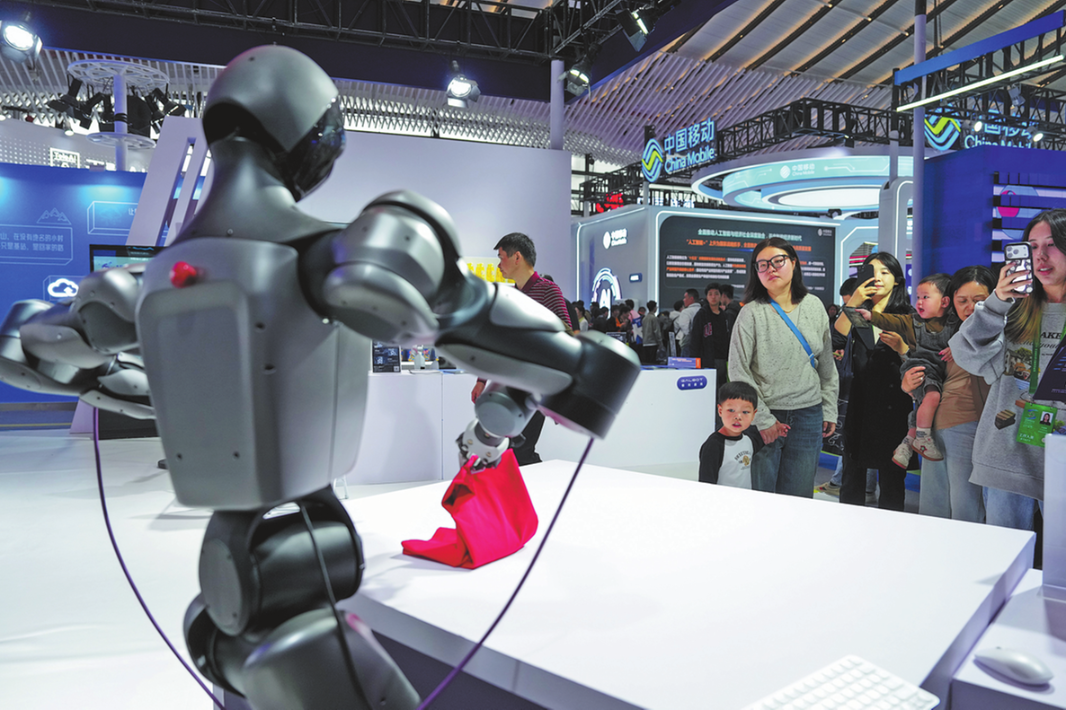
Tao said that Tesla is transforming from a mere electric vehicle maker to a technology enterprise centered on AI, robotics, and energy.
"Vehicles remain an extremely important AI carrier, but our vision has expanded to humanoid robots and a global energy network," Tao said. "This transformation is based on the judgment that the future world will be driven by electricity, while AI will manage these hardware systems."
Globally, Tesla's capital expenditure is expected to exceed $20 billion in 2026. The investment will focus on AI computing power, robotic factories, mass production of the Cybercab, and energy storage.
Tao added that the launch of the Shanghai energy storage Gigafactory will provide competitive Megapack products for China, the Asia-Pacific, and Europe. She emphasized that as AI development drives demand for computing centers, energy storage systems will become crucial for grid stability.
The US carmaker's deepened commitment coincides with the rapid expansion of China's AI sector.
China has also become the largest holder of AI patents, accounting for 60 percent of the global total. Meanwhile, the cumulative downloads of domestic open-source large models have surpassed 10 billion.
This robust growth has prompted global investors to reevaluate the Chinese market.
Jerry Wu, a fund manager at London-based Polar Capital, said Chinese innovation assets are undergoing a "re-rating" following breakthroughs by Chinese AI model DeepSeek.
Wu said that the momentum extends beyond DeepSeek to biotechnology and robotics. His firm, which manages $20 billion in assets, shifted its view on Chinese assets from "underweight" to "bullish" late last year.
German media outlet Wirtschaftswoche reported on its website earlier that breakthroughs by Chinese developers are encouraging investors to reexamine the market.
Zheng Yuchen, chief investment officer at Allianz Global Investors, observed a significant shift in sentiment. "A year ago, they wanted to exclude China from indexes. Today, China is viewed as an independent investment category that cannot be ignored," Zheng said.
Wang Ying, chief equity strategist for China at Morgan Stanley, said global investors are redefining China from a market that lacked clear growth to one that offers rich opportunities in AI, automation, and high-end manufacturing.
Looking ahead, Xiong Wei, an analyst at UBS Securities, predicts that domestic large model capabilities will rapidly iterate to catch up with US peers this year.
Xiong added that China and the United States are on similar AI monetization paths, with cloud computing and advertising being the most visible areas.
Wang Zonghao, head of China equity strategy research at UBS, said foreign capital is expected to continue increasing positions in the Chinese market.
"We have seen a significant improvement in overseas investors' recognition of Chinese innovation,"Wang Zonghao said, noting that the firm is particularly bullish on hardware and internet applications within the AI sector.
renqi@chinadaily.com.cn