Ultra-fast charging keeps motorists on the move
By Luo Wangshu | China Daily | Updated: 2026-02-24 09:02


Three days into China's 2026 Spring Festival travel rush on Feb 4, traffic flow at the Majuqiao service area — southeast of Beijing along the Beijing-Shanghai Expressway — appeared calm and orderly, belying the scale of the country's annual mass migration.
In the morning, streams of vehicles — cars, trucks, and buses alike — moved smoothly in and out of the service area. Many were new energy cars, stopping briefly to recharge before continuing their journeys. Charging zones are clearly marked, with fast-charging and ultra-fast-charging areas distinguished by green and yellow signage, making them easy to identify from a distance.
An NEV owner surnamed Xu from Beijing pulled into the ultra-fast-charging area, scanned a QR code at the charging post, and stepped out for a short break. Twenty minutes later, he was ready to leave.
"My car indicates a range of about 500 kilometers when fully charged," Xu said. "Ultra-fast charging usually takes 20 to 30 minutes, while regular fast charging takes about 40 minutes. I rarely charge at home now — it's quicker outside."
Xu said charging anxiety, once a common concern among electric vehicle users, has largely disappeared. "Earlier, you had to plan carefully around charging stations. Now you can search online anytime, and there's almost always one nearby. The car also tells you when and where you'll need to recharge along the way."
He switched to an electric vehicle over a year ago, citing both convenience and cost. Beijing's traffic restrictions based on license plate numbers can complicate travel plans, he said, while an electric car offers greater flexibility. "Charging costs are low. With about 100 ($14.47) to 200 yuan, I can drive for nearly half a month. A full charge costs only a few dozen yuan, and often I just top up to around 80 percent."
The Majuqiao service area is a key gateway linking Beijing with the broader Beijing-Tianjin-Hebei region and ranks among the most important hubs along the Beijing-Shanghai Expressway. During this year's chunyun, or Spring Festival travel rush, it is expected to handle a significantly higher volume of vehicles than usual, with traffic concentrated but stable.
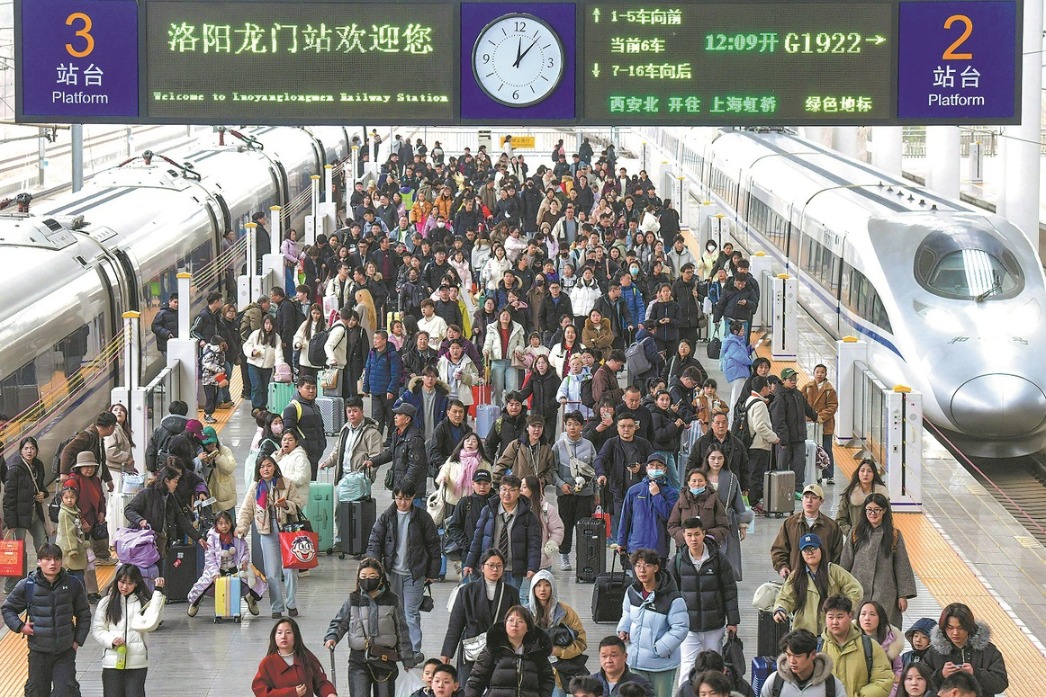
Xu is just one of the hundreds of millions taking to China's roads during the 40-day travel season, which began on Feb 2 and runs through March 13.
With cross-regional trips expected to hit 9.5 billion, this year's Spring Festival travel rush could be the largest in history — a massive migration that reunites families while testing the country's transportation system. Self-driving trips are forecast to account for roughly 80 percent of journeys, while rail and civil aviation passenger volumes are expected to reach 540 million and 95 million, respectively.
Road revolution
As self-driving travel dominates, charging infrastructure has become critical. Beijing has now achieved full coverage of charging facilities, including ultra-fast chargers with a maximum power of 600 kilowatts, allowing some models to replenish energy in as little as 15 minutes.
"With ultra-fast charging, some NEV owners can refill their batteries in 15 minutes, enjoying an experience similar to refueling," said Lyu Yanhua, an official with the Beijing Municipal Commission of Transport's highway administration department.
This marks Beijing's entry into the "600-kW ultra-fast charging era" along expressways.
According to the Beijing Municipal Commission of Transport, the city had installed 530 charging piles and 674 EV charging parking spaces by the end of 2025, with one charging pile often serving multiple parking spaces through smart power allocation. One in four passenger vehicle parking spaces in Beijing is equipped with charging facilities, placing the city among the top regions nationwide.
A total of 66 ultra-fast charging units have been installed across all service areas in Beijing, providing full coverage.
In 2025 alone, Beijing completed the construction of 42 ultra-fast charging stations across 12 service areas, including locations along the Beijing-Kunming, Beijing-Hong Kong-Macao, Beijing-Xizang and Beijing-Chengde expressways, further improving fast-charging accessibility for long-distance travelers.
At the operational level, expressway operators expanded ultra-fast charging capacity ahead of Spring Festival. "We added 17 new ultra-fast stations compared with last year," said Wang Zhanqin, deputy general manager of Beijing Shoufa Industry and Trade Co, a subsidiary of Beijing Capital Highway Development Group Co. "Some new stations use 600 — or 720-kW liquid-cooled systems, allowing vehicles to be ready in 15 minutes."
Twelve mobile charging vehicles were also deployed at high-traffic service areas along major expressways, including the Beijing-Shanghai and Beijing-Hong Kong-Macao routes. Drivers can call the 24-hour hotline 96011 for emergency assistance or mobile charging support.
National coordination
At the national level, the Ministry of Transport identified NEV charging as a key priority during chunyun. By the end of 2025, China's NEV fleet had reached nearly 44 million units, with 12.93 million new registrations last year. Transport authorities expanded expressway charging networks to more than 71,500 charging guns at service areas, with 20,000 added in 2025.
"We expect the proportion of trips made by new energy vehicles to increase compared with usual, with total NEV journeys during this Spring Festival projected to hit a record 380 million trips," Gao Bo, deputy director of the ministry's transport department, said.
Measures such as mobile charging units, real-time information sharing, and service-area-specific contingency plans aim to ease peak demand.
The ministry has also implemented a 2026 service area upgrade plan.
"More than 10,000 new charging piles will be added to service areas in 2026, with over a quarter being high-power chargers, providing greater convenience for NEV drivers," said Ma Ji, deputy head of the ministry's highway bureau.
She also noted that the ministry will dynamically analyze service area demand, increase mobile chargers, optimize parking guidance, and deploy teams to assist regions with the heaviest load.
"Safety is the fastest way home," Gao said. Drivers are urged to plan charging stops and allow extra time during cold weather conditions.
For travelers like Xu, the effect is less policy than practice. "You stop, charge, and go," he said, glancing at his dashboard as the battery level climbed. Within minutes, he was back on the expressway — one traveler among billions, moving through a system designed to keep China flowing even at its busiest moment.