Smart economy gateway to immense potential
AI in China moving beyond labs to become foundational architecture for industrial growth, systemic economic development
By Ma Si | China Daily | Updated: 2026-03-12 09:59


For years, artificial intelligence has largely been viewed through a lens of technological breakthroughs, algorithmic benchmarks and limited commercial applications.
However, for the first time, the 2026 Government Work Report has introduced the goal of creating new forms of smart economy.
To industry insiders and foreign investors, this significant linguistic shift signals a clear message — that AI in China is moving beyond the lab and simple "tool empowerment" to become the foundational architecture for industrial growth and systemic economic development.
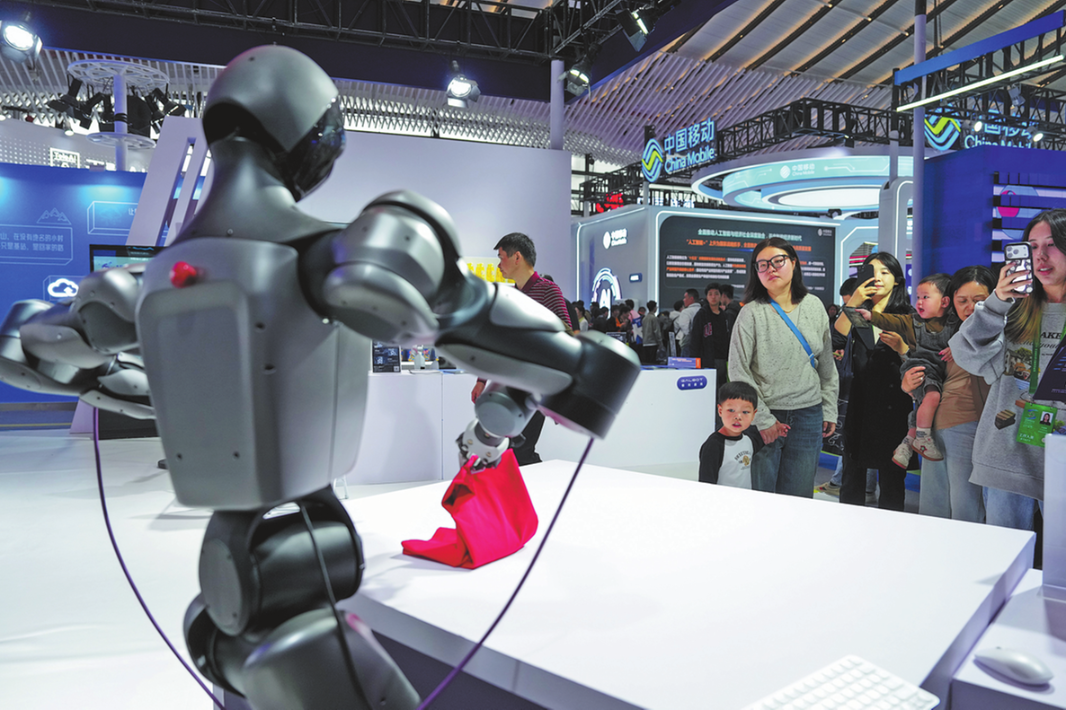
This evolution represents a profound opportunity. As the world's second-largest economy pivots, the emergence of the smart economy — encompassing everything from AI-native software to embodied robotics — is poised to become a primary driver of new growth, offering a vast landscape of opportunities for both domestic and foreign corporations, company executives and experts said.
Chen Changsheng, a member of the drafting team for the Government Work Report and deputy director of the Research Office of the State Council, provided the official interpretation of this new terminology. "By proposing to create new forms of smart economy for the first time, we aim to seize the opportunities presented by AI development and expand the breadth and depth of AI empowerment across all industries," Chen said.
This shift is not merely semantic. It reflects a recognition that AI has the potential to deliver tangible economic output at scale.
Liu Qingfeng, a deputy to the National People's Congress and chairman of iFlytek — a pioneer in intelligent speech and AI technologies — resonated with this strategic direction.
"What impressed me the most is the introduction of new forms of smart economy," Liu said. "It provides very clear guidance and requirements on how to achieve in-depth, large-scale commercial application of the 'AI Plus' initiative, including areas like smart terminals, AI agents and AI-native applications. I believe this will serve as a significant and positive boost for the next phase of AI development."
Photo